VuwCTF 2025
I played VuwCTF 2025 with tjcsc. We got 5th place!
Challenge: string-inspector
Category: Reverse Engineering
Author: maxster
Flag (intended): VuwCTF{0027094767331}
Alt flag I stumbled on first: VuwCTF{1720554767331} (binary accepts it, but the author marked it unintended)
My initial read / first impressions
There was only one file given: a binary. I always start by seeing what I’m dealing with:
chmod +x inspector
file inspector
# ELF 64-bit LSB executable, x86-64, statically linked, stripped
Running it with no arguments:
./inspector
# Enter flag as argument to this program
So it expects the flag on the command line. Before diving into a disassembler, I like to skim the readable parts:
strings -n 6 inspector | head
# Flag rejected!
# Flag accepted!
# Analyzing flag: %s
# VuwCTF{
# 0000000000042
# 0319993
The VuwCTF{ plus the two numeric strings (0000000000042 and 0319993) looked like check constants. My instinct felt like the flag would be VuwCTF{<digits>} with some math involving those numbers.
Recon: what does it actually do?
First, I tried a dummy flag:
./inspector VuwCTF{testflag}
# Analyzing flag: VuwCTF{testflag}
# Flag rejected!
To see how it rejects, I watched the syscalls with strace:
strace -f ./inspector VuwCTF{0000000000042} 2>&1 | head -n 40
The interesting part of the trace:
execve("./inspector", ["./inspector", "VuwCTF{0000000000042}"], ...) = 0
...
execve("./inspector", ["./inspector", "0000000000042", "0000000"], ...) = 0
...
write(1, "Flag rejected!\n", 15) = 15
After checking the wrapper, it immediately re-executes itself with three arguments: the digits-only string and a helper string of seven zeroes. That’s very useful info! The real verification logic runs in this “three-argument” mode, and the initial run is just a wrapper.
Disassembly: wrapper mode
Opening it in GDB and disassembling around the entry point (0x401790):
gdb -q ./inspector
(gdb) disassemble 0x401790,0x401950
The wrapper logic (as I understood it) was:
- If you don’t give at least one arg, it prints “Enter flag…” and exits.
- In this mode it wants exactly one arg.
- It checks:
- total length is 21,
- the string starts with
VuwCTF{and ends with}, - the 13 characters inside are all digits.
- On failure, it prints “Flag rejected!”.
- On success, it calls:
execve(argv[0], [argv[0], digits_only, "0000000"], NULL);
Then it exits. So the first run is just input validation and argument rewriting.
The real checker: manual long division
The second run (with digits + seven zeroes) is where the work happens. Disassembling around 0x4018d0 to 0x401a40 shows a hand-rolled long division on the decimal string:
- It divides the decimal string by the constant 84673. There isn’t anything fancy here. The code literally iterates the characters like you would do on paper: bring down a digit, compute a quotient digit, carry the remainder.
- While dividing, it builds two strings:
- A remainder string, zero-padded to 13 digits.
- A quotient suffix string holding the last 7 digits of the quotient.
- When done, it compares those strings against hard-coded targets in
.rodata:- remainder must be
0000000000042(i.e., remainder 42), - quotient tail must be
0319993(i.e., quotient ≡ 319993 mod 10^7).
- remainder must be
- If both match, it prints “Flag accepted!”, otherwise “Flag rejected!”.
You can see the constants directly:
objdump -s -j .rodata inspector | sed -n '0x7f040,0x7f080p'
# shows "VuwCTF{", "0000000000042.", nearby bytes

gdb> x/s 0x47f052
# "0000000000042"

gdb> x/gx 0x401989
# 0x33393939313330  -> little-endian ASCII "0319993\0"
The multiple execve calls in the earlier strace make sense now: the binary keeps re-launching itself while it walks the digits and builds those strings.
Solving the math
Let N be the 13-digit number inside the braces.
From the code we need:
N ≡ 42 (mod 84673)⌊N / 84673⌋ ≡ 319993 (mod 10^7)Nrenders as exactly 13 decimal characters. Because the binary keeps the literal string, leading zeroes are allowed and significant.
Write N = 84673 * Q + 42, where Q ≡ 319993 (mod 10^7).
So Q = 319993 + 10^7 * t for some integer t ≥ 0, and:
N = 84673 * (319993 + 10_000_000 * t) + 42
I checked small t with a tiny Python snippet:
mod = 84673
req_q = 319993
req_r = 42
for t in range(0, 5):
    n = mod * (req_q + t*10_000_000) + req_r
    s = f"{n:013d}"
    print(t, n, s)
Output:
0 27094767331 0027094767331
1 873824767331 0873824767331
2 1720554767331 1720554767331
All three are 13 characters long. Because the checker treats the decimal string literally, all three pass the division checks.
The detour: unintended flag (not orz, braincell loss)
I initially tried the “clean” non-leading-zero version:
./inspector VuwCTF{1720554767331}
# Flag accepted!
I submitted that to the CTF website, but it did not work… So I did what any dumb person would do: proceed to doubt myself when I literally had two other possible answers.
After a few crash outs, I made a ticket. I’ll let the conversation speak for itself:
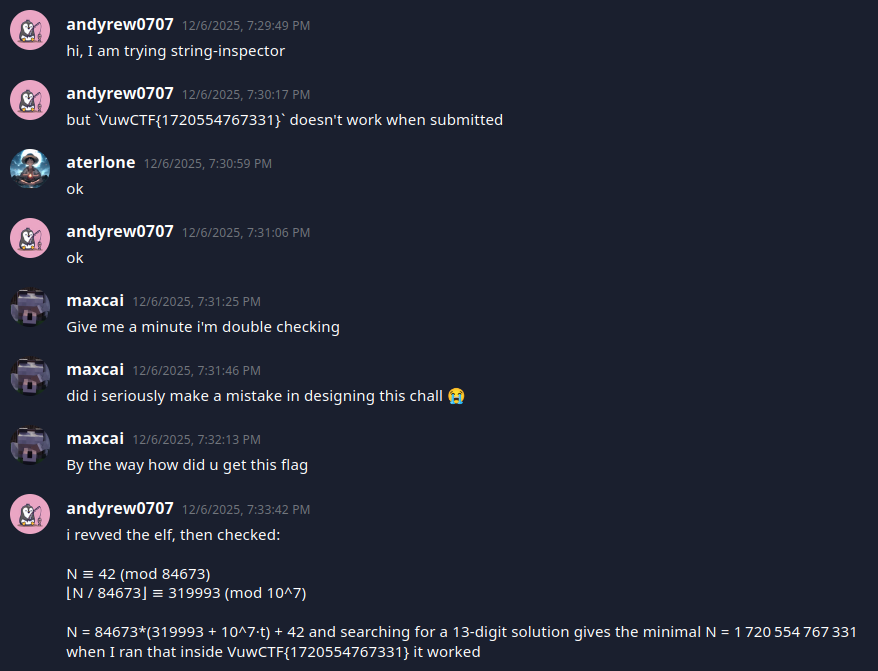
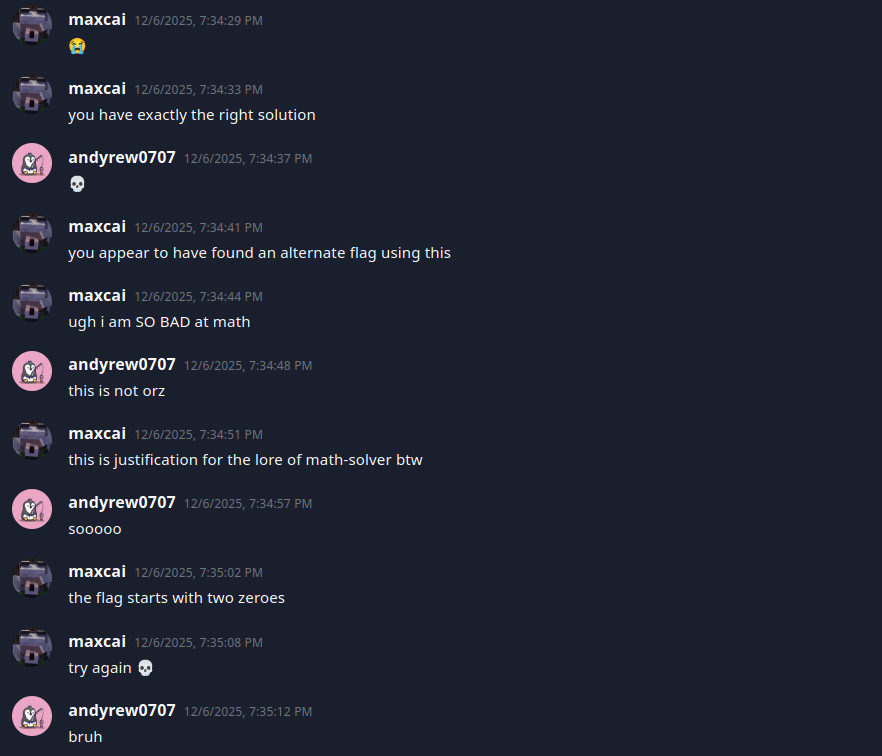
This confirmed I did solve it correctly, but I had an alternate flag. Max, if you’re reading this, in the future please include all possible flags as correct answers 😭
At least now, I knew the intended flag “starts with two zeros”. Well, now I knew what the flag was. Trying the only answer with two leading zeros:
./inspector VuwCTF{0027094767331}
# Flag accepted!
That was the official flag! The final flag was: VuwCTF{0027094767331}.
Other than both Max and I losing some braincells, it was a pretty fun challenge!
Takeaways
- Start with the easy triage:
file,strings, andstracecan reveal control-flow tricks (here, self-execve) before you open a disassembler. - Even stripped static binaries leak constants in
.rodata; spotting ASCII gives you the targets to aim for. - If a checker treats input as a string, leading zeroes can produce multiple “valid” answers. If a platform rejects your locally accepted flag, consider the exact formatting the code expects (and don’t hesitate to make a ticket for clarification).
Thank you for reading my write-up! This was an extremely fun CTF, and I would like to express my appreciation to the organizers for hosting the CTF!
If there’s anything you think I could improve on in future write-ups, please let me know!
Thank you and have a great day!